
document_navigation.md 2.6 KB
Document Navigation
1. General Document Variables
You will see the following document variables in all FATE Flow documentation, with the following meanings.
- FATE_PROJECT_BASE: denotes the
FATE projectdeployment directory, containing configuration, fate algorithm packages, fate clients and subsystems:bin,conf,examples,fate,fateflow,fateboard,eggroll, etc. - FATE_BASE: The deployment directory of
FATE, namedfate, contains algorithm packages, clients:federatedml,fate arch,fate client, usually the path is${FATE_PROJECT_BASE}/fate - FATE_FLOW_BASE: The deployment directory of
FATE Flow, namedfateflow, containingfate flow server, etc., usually the path is${FATE_PROJECT_BASE}/fateflow - FATE_BOARD_BASE: the deployment directory of
FATE Board, namefateboard, containsfateboard, usually the path is${FATE_PROJECT_BASE}/fateboard EGGROLL_HOME: the deployment directory for
EggRoll, namedeggroll, containingrollsite,clustermanager,nodemanager, etc., usually in${FATE_PROJECT_BASE}/eggrollDeploy the
FATE projectwith reference to the main repository FederatedAI/FATE, the main directory structure is as follows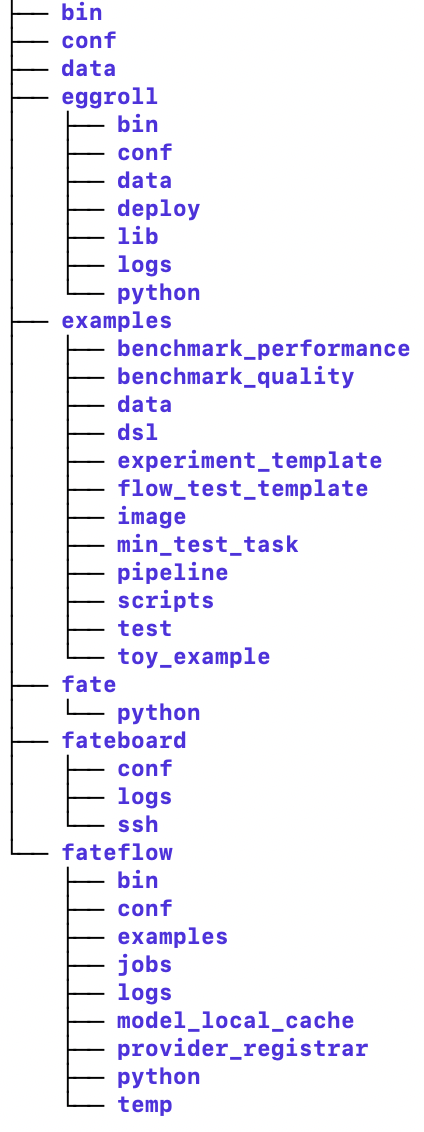 {: style="height:566px;width:212px"}
FATE_VERSION: The version number of
FATE, e.g. 1.7.0FATE_FLOW_VERSION: the version number of
FATE Flow, e.g. 1.7.0version: Generally in the deployment documentation, it means the version number of
FATE project, such as1.7.0,1.6.0.version_tag: generally in the deployment documentation, indicates the
FATE projectversion tag, such asrelease,rc1,rc10
2. Glossary of terms
component_name: the name of the component when the task is submitted, a task can have more than one of the same component, but the component_name is not the same, equivalent to an instance of the class
componet_module_name: the class name of the component
model_alias: similar to component_name, which is the name of the output model that the user can configure inside dsl
Example.
In the figure dataio_0 is component_name, DataIO is componet_module_name, dataio is model_alias
! [](https://user-images.githubusercontent.com/1758850/124451776-52ee4500-ddb8-11eb-94f2-d43d5174ca4d.png)

3. Reading guide
- you can first read overall design
- Refer to the main repository FATE for deployment, either standalone (installer, Docker, source compiler) or cluster (Ansible, Docker, Kuberneters)
- You can refer to the directory in order of navigation